
The Bitty Bee Buddy: A FREE Crochet Bee Pattern
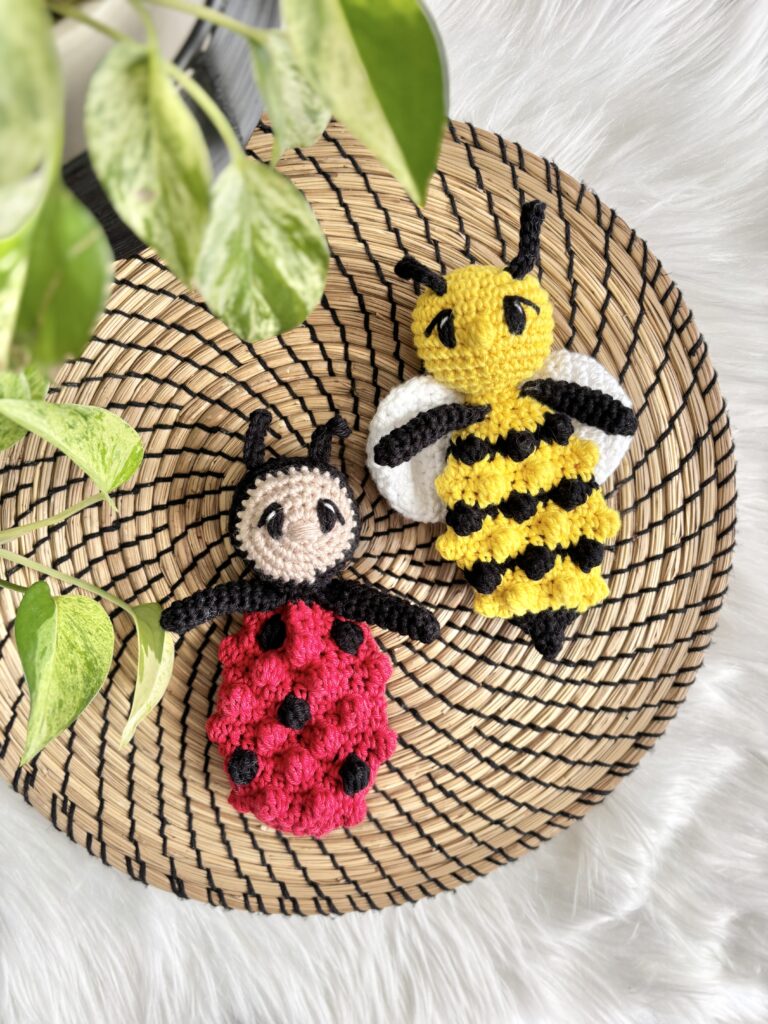
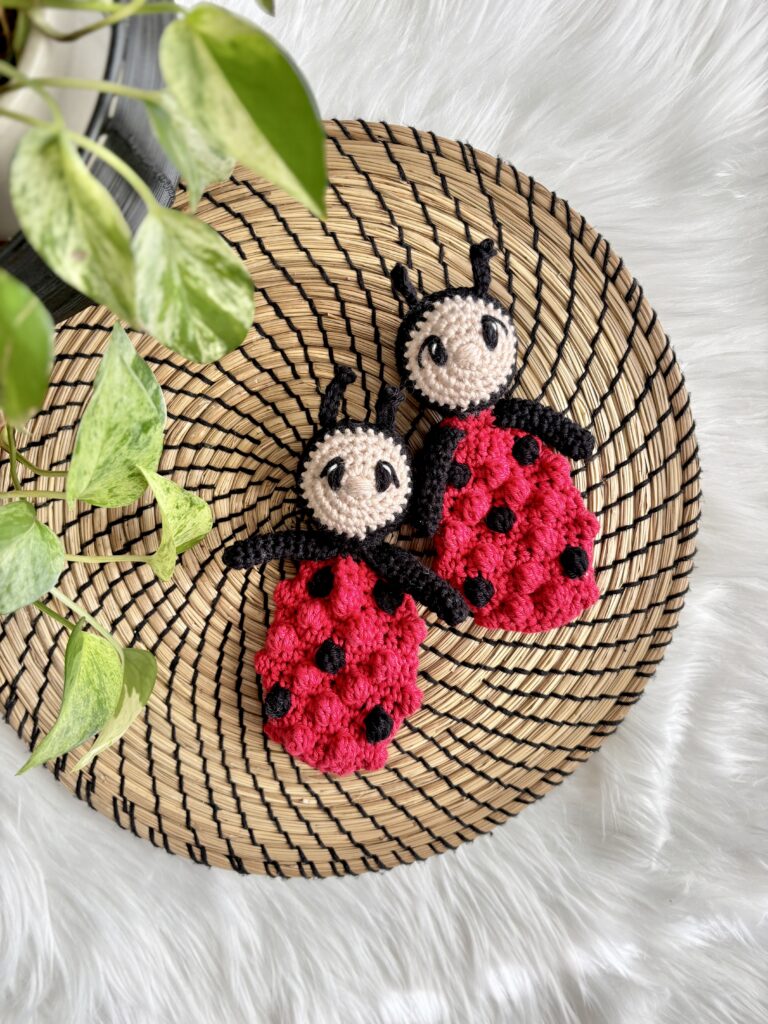
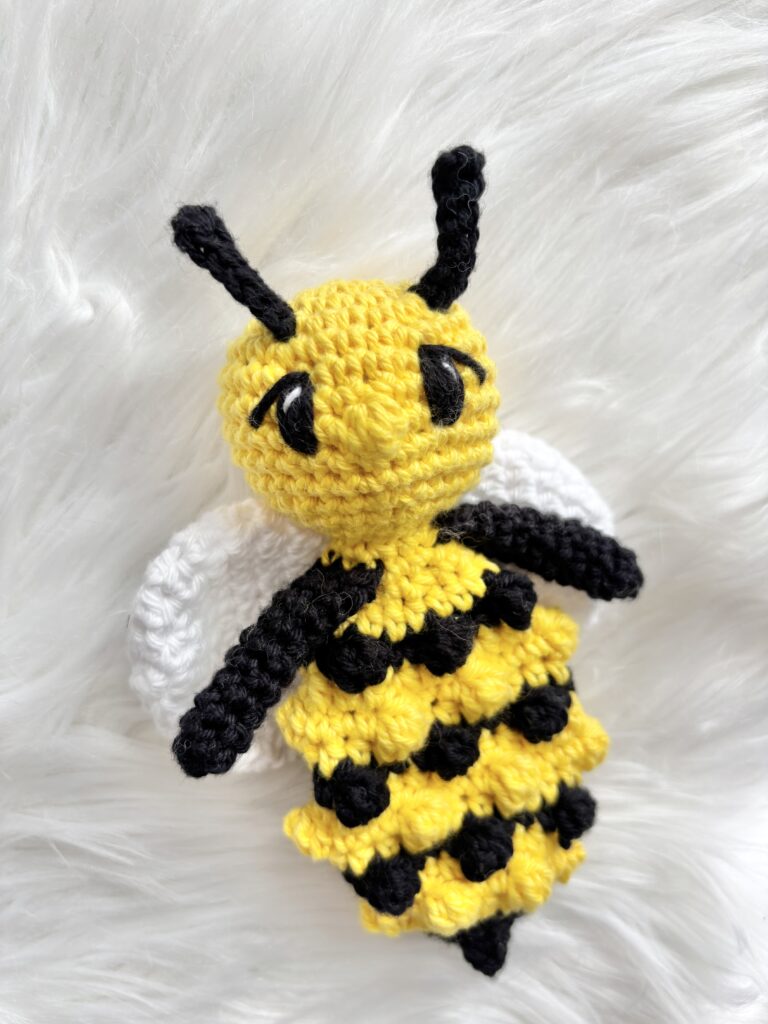
April showers bring May…bugs. But at least these ones are cute! There are TWO new bitty buddies joining the crew today – the bitty ladybug and the bitty bee! No scaries from these cute critters though, they are sweet enough to snuggle! Today I’m sharing the bitty bee as this month’s free bitty buddy pattern!
This new bitty buddy is quick, simple and beginner-friendly! Add a rattle insert or crinkle paper for a sweet noise maker or pop on a wooden teething ring for a tiny teether! Bitty buddies make some adorable little gifts for any baby you love. Read on to find out how you can make your very own FREE crochet bee pattern.
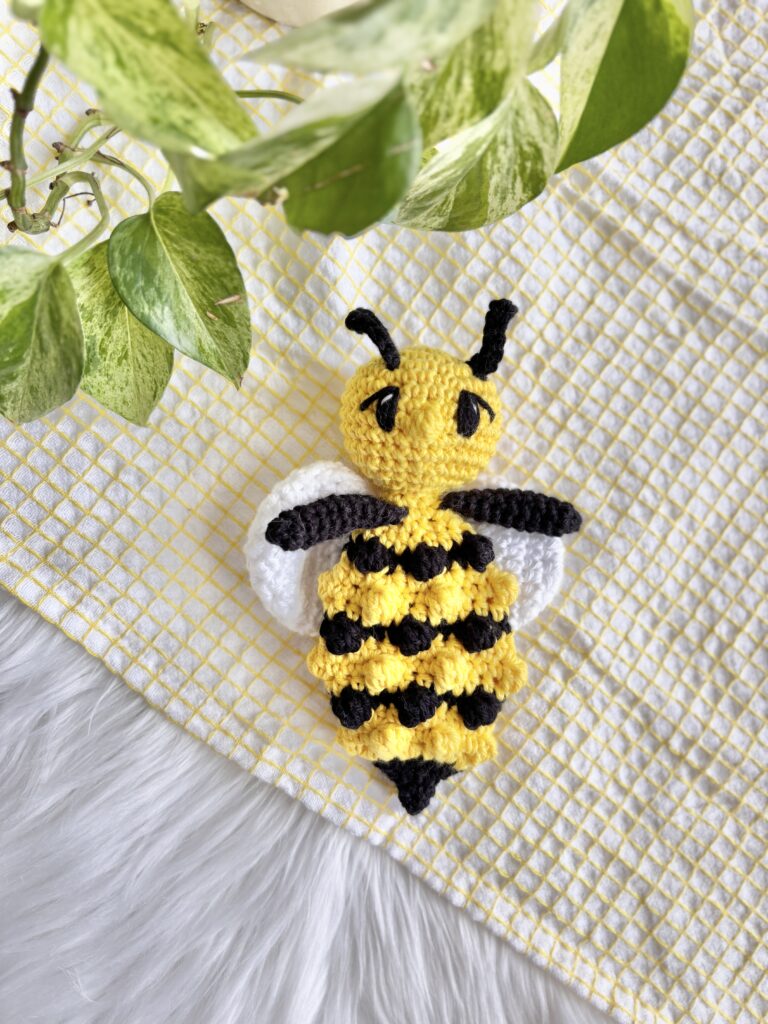
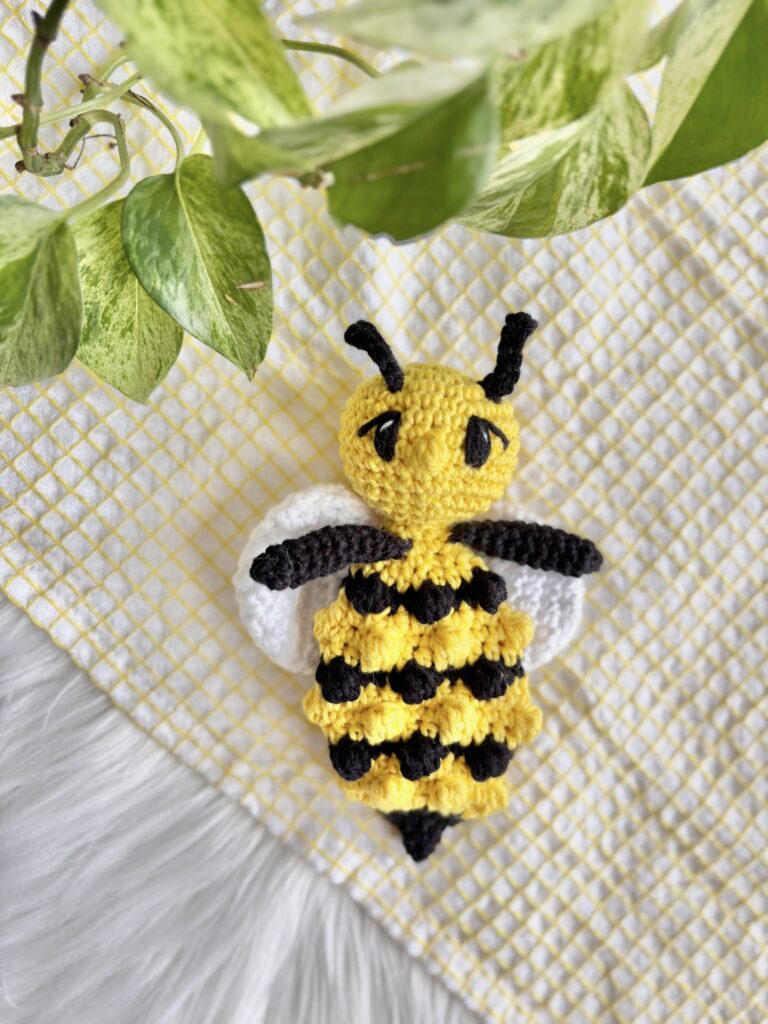
The Bitty Bee Buddy is a unique design in the Bitty Buddy Collection featuring the bobble stitch. Bitty buddies are a tiny-sized cross between a security blanket and favorite stuffed animal, making them the perfect little loveys. They are teeny and sweet and make great rattles, teether toys or binky buddies! The bobbled texture and soft body structure provide great sensory input while the cute animal designs make them fun for play! Check out the full collection!
If you prefer the ad-free printable version of the bitty bee, you can find it on Etsy or Ravelry.
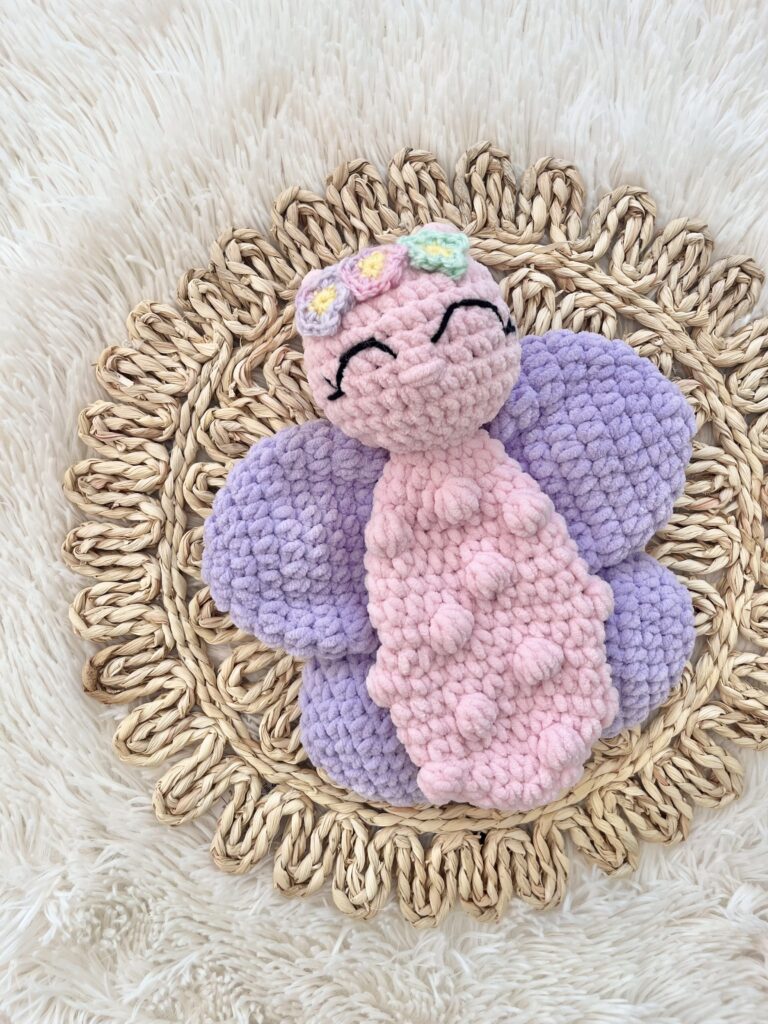
Bitty Bee is a new bug in the bitty bug collection! Check out the bitty butterfly and bitty ladybug!
Don’t miss a free pattern! Subscribe to the newsletter to keep up with all the latest!
As I’ve said before, these bitties are meant for babies, so I typically prefer cotton yarn like Hobby Lobby, I Love This Cotton yarn or Lion Brand, 24/7 cotton. For this free crochet bee pattern, I worked up some new-to-me cotton yarn from WeCrochet and let’s just say I may have a new favorite! In general, cotton yarn works up nicely and is great for teething babies to chew on. It doesn’t have loose strands of fiber shedding off, it is easy to wash and it just gets softer and softer over time. I used Dishie yarn from WeCrochet which is a 100% cotton yarn. It is just a tiny bit stiffer than I Love This Cotton but feels really soft and especially sturdy! The fibers are tightly woven and the color choices are gorgeous. The stitches are well defined and the bobbles really POP! I think Dishie yarn will be a great choice for bitty buddies and will hold up to the test of baby play!
You can use other acrylic blends for these patterns, I just prefer the cotton. I know plush has become SO popular too, so if you are looking to use something bulky, I recommend Premier, Parfait Chunky or Joann’s Big Twist Baby Bear.
Please note: This post contains affiliate links which means that if you purchase through the link, I may receive a small commission at no cost to you. Thank you for supporting my small business
MATERIALS:
Materials needed for this little free bee crochet pattern will vary based on the type of yarn you choose. If you choose a size 4 yarn as pictured, you will need smaller hooks and slightly less yardage of yarn whereas if you use a size 5 or 6 yarn, you will need larger hooks and slightly more yardage of yarn. A quick note about bulkier yarns – these patterns can work well with size 5 bulky yarn or with a very thin “size 6” yarn. I do not recommend using this pattern with Bernat Blanket Yarn as I feel that it just comes out far too bulky! See the bitty butterfly pattern in my shop if you’d like a body style that works well with super bulky!
HOOK(S): [My all-time favorite hooks are Clover Amour hooks]
- For Size 4 Cotton/Acrylic Yarn:
4.0 mm • US size G - For Bulkier Yarn (Parfait Chunky):
5.0 mm • US size H
YARN: [I’ve used Hobby Lobby and Premier Parfait Chunky for this project]
- Weight : Worsted
- We Crochet, Dishie
- Bumblebee, ~50 yds
- Black, ~20 yds
- Hobby Lobby, I Love This Cotton Yarn
- White, ~ 35 yds
- We Crochet, Dishie
NOTIONS
- Darning Needle
- Embroidery Thread
- Measuring Tape
- Polyfil Stuffing
- Rattle Insert (if desired)
- Scissors
- Stitch Marker (if desired)
- Teething Ring (if desired)
GAUGE
Exact gauge is not necessary for this project
FINAL HEIGHT
~7-8 inches from top to bottom
OK, let’s get started!
If you prefer the ad-free printable version, you can find it on Etsy or Ravelry. Use code BITTY to save on any of the bitty buddy patterns!
Here’s a quick note! Most of my patterns use the bobble stitch. This is a unique stitch that creates bobbles which pop up off of the work to add to the texture and overall look of the project. For infants and children, this unique texture creates interest and great sensory input in their toy! I work my bobbles in the round by pushing them towards me rather than away from me so they end up on the outside of the work in the round. If you need help with this technique, see this stitch tutorial and check out this video which gives directions on how to work the bobble stitch in the round. The pattern featured in this video is the free pineapple plush, but the technique used is the same. On to the free crochet penguin pattern!
STITCH ABBREVIATIONS:

SPECIAL STITCHES:
BOBBLE STITCH (bobble): tutorial here
To make a bobble stitch you will work multiple double crochets into the same stitch.
(Yo, insert hook into st, draw up a loop, yo, pull through first two loops on hook) and repeat 3 more times. End with 5 loops on the hook – yo, pull through all 5 loops.
See this stitch tutorial for a step-by-step description with photos here.
You can choose to make the bobbles on the right or the wrong side of your project, just make sure they are on the outside of the body when finished.
3 DC Bobble: For the face of the bumblebee, add a nose by working a 3dc bobble. This stitch is worked exactly the same as the description above but with 2 more repeats, not 3. End with 4 loops on the hook – yo, pull through all 4 loops.
DECREASE STITCHES (hdc2tog/sc2tog): To decrease stitches, you will hdc or sc 2 stitches together to decrease the stitch count. Pattern indicates which stitch to use for these decreases.
INCREASE STITCHES (inc): To increase stitches, you will sc or hdc 2 stitches into the same spot.
PATTERN:
MAKING THE ARMS: (Make Two)
Arms are optional for your bug. Make arms in black. Stitch counts are included at the end of each round.
Round 1: To begin, make a magic circle. Place 6 sc in the magic circle. Do not join. Continue to work in the round. [6]
Rounds 2-10: sc x 6 around. (9 rounds, 54 sts) [6]
Round 11: Pinch the top of the arm together and place 3 sc across the top, making sure to go through stitches on each side in order to close off the arm. Cut yarn, tie off and weave in ends. Leave the arms unstuffed. Make two and set aside for assembly. [3]
MAKING THE HEAD:
Use a 4.0 mm hook for the head. Make the head in yellow. Stitch counts are included at the end of each round.
Round 1: To begin, make a magic circle. Place 6 sc in the magic circle. Do not join. You will continue to work in the round. [6]
Round 2: [sc inc] in each st around. [12]
Round 3: [sc inc, sc] x 6. [18]
Round 4: [sc inc, sc x 2] x 6. [24]
Round 5: [sc inc, sc x 3] x 6. [30]
Rounds 6-7: sc x 30 around. (2 rounds, 60 sts) [30]
Round 8: sc x 14, 3dc bobble, sc x 15. [30]
Rounds 9-10: sc x 30 around. (2 rounds, 60 sts) [30]
Round 11: [sc2tog, sc x 3] x 6. [24]
*Stop here. If desired, add safety eyes between rounds 7-8, 6 sts apart. Begin stuffing head firmly. Add rattle insert before closing head, if desired.
Round 12: [sc2tog, sc x 2] x 6. [18]
Round 13: [sc2tog, sc] x 6. [12]
Round 14: [sc2tog] x 6. [6]
Leaving a bit of a tail, cut and tie off your yarn. Thread a needle and sew under the front loop of each remaining stitch. Cinch tightly together to close the neck of the head. Tie off and weave in your ends.
MAKING THE BODY:
Use a 4.0 mm hook for the body. Stitch counts are included at the end of each round. Bobble rows include [total # stitches, # bobble stitches].
The body is made by alternating yellow and black. Do not cut yarn between color changes. Simply drop the color and pick back up when needed again. In the pattern below, stitches that should be in black are in bold. All other stitches will be in yellow.
Round 1: To begin, make a magic circle using black. Place 4 sc stitches in the magic circle. Do not join. You will continue to work in the round. [4]
Round 2: sc inc, sc x 3. [5]
Round 3: sc inc, sc x 4. [6]
Round 4: [hdc inc, hdc] x 3 around. [9]
Round 5: [hdc inc, hdc x 2] x 3 around. {Drop black and switch to yellow.} [12]
Round 6: [hdc inc, hdc] x 6 around. [18]
Round 7: [sc x 2, bobble] x 6 around. [18, 6 bobbles]
Round 8: [hdc inc, hdc x 2] x 6 around. {Drop yellow and switch to black.} [24]
Round 9: sc x 2, bobble, [sc x 3, bobble] x 5, sc. {Drop black and switch to yellow.} [24, 6 bobbles]
Round 10: hdc x 24 around. [24]
Round 11: sc, [bobble, sc x 3] x 5, bobble, sc x 2. [24, 6 bobbles]
Round 12: hdc x 24 around. {Drop yellow and switch to black.} [24]
Round 13: [bobble, sc x 3] x 6. {Drop black and switch to yellow.} [24, 6 bobbles]
Round 14: hdc x 24 around. [24]
Round 15: [sc x 3, bobble] x 6 around. [24, 6 bobbles]
Round 16: [hdc x 2, hdc2tog] x 6 around. {Drop yellow and switch to black.} [18]
Round 17: sc, bobble, [sc x 2, bobble] x 5, sc. {Fasten off black and switch to yellow.} [18, 6 bobbles]
Round 18: hdc x 18 around. [18]
Round 19: [sc, sc2tog] x 6 around. [12]
At this point, you will add the arms to your bee, to avoid having to sew them in later. Both arms should be closed with three stitches across.
*Note: The arms in round 20 are optional. If you would like to omit the arms on your bee, sc x 12 in round 20 without adding any arms in.
Round 20: sc x 4. Now, place your arm on the outside of the body and sc x 3 through both the arm and the stitches of the neck to attach. sc x 2. Now, place your second arm on the outside of the body and sc x 3 through both to attach. [12]
Round 21: [sc x 2, sc2tog] x 3. [9]
Slip stitch to first stitch and then, leaving a long tail to attach the head to the body, cut yarn and tie off.
MAKING THE WINGS:
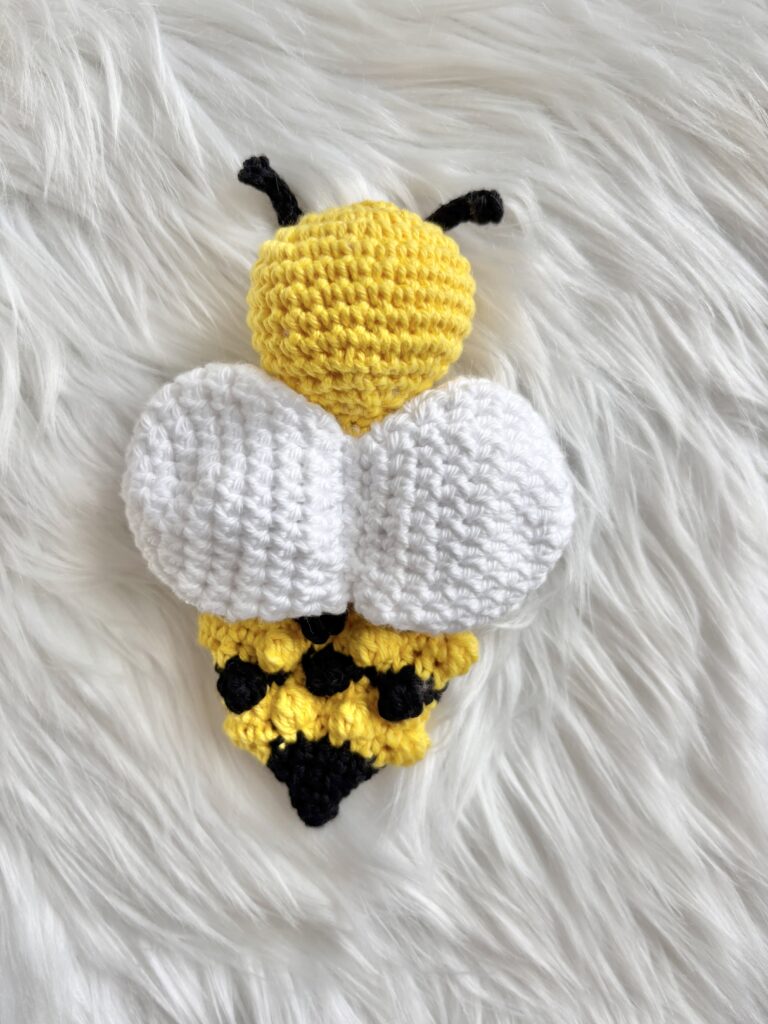
The wings are made in TWO separate pieces. There will be two wings that will be made and then joined together. The wings will then be sewn to the back of the bee during assembly. Use white for the wings.
Round 1: To begin, make a magic circle. Place 6 sc in the magic ring. Do NOT join. Continue working in the round. Use a st marker in the first st of each round, if desired. [6]
Round 2: [hdc inc] x 6 around. [12]
Round 3: [hdc inc, hdc] x 6 around. [18]
Round 4: [hdc, hdc inc, hdc] x 6 around. [24]
Round 5: [hdc x 7, hdc inc] x 3 around. [27]
Rounds 6-7: hdc x 27. (2 rounds total, 54 sts) [27]
Round 8: hdc dec, hdc x 21, hdc dec x 2. [24]
Round 9: hdc dec, hdc x 18, hdc dec x 2. [21]
Round 10: hdc dec, hdc x 9. This will only be a partial round. [10] Sl st in the next st. Ch 1.
Round 11: Fold the open edge of the wing together and sc x 10 across to close off the wing (photo A). Tie off and leave a long tail for cinching and sewing.
On the second wing, do not tie off. Ch 1. Stack the wings on top of each other, making sure to line up the rounded edges so the wings match (photo B).
Now, sc x 10 through both wings in order to join them together (photo C). Cut yarn and leave a long tail for assembly.
*Note: These photos show the wings in bulky weight yarn but the technique is the same*

MAKING THE WINGS:
ASSEMBLING WINGS
You should now have two connected wings. These pieces need to be “cinched” down the middle before sewing to the body of the bee.
You should have yarn tails at both sides of the center of the wings. Using an embroidery needle and one of the yarn tails, weave the tail through the stitches along the right side of the center and then back along the left side of the center (photo D). When you pull on the tail, this should pull the stitches together to cinch. You can cinch as tightly or loosely as desired (photo E).
Cinch this way and then sew to the back of the bee.


SEWING WINGS
Sew the wings before or after assembling the entire bee. If you prefer to assemble first, move to assembly and then come back to sew the wings on at the very end.
Turn the body of the bee over so the backside is facing up. Fold the wings in half and sew along the center fold of the wings to the center back of the bee. Aim to sew the wings across rounds 14-20 on the back of the body.
Weave in ends after attaching the wings.
ASSEMBLY OF YOUR BITTY BEE:
You should now have the body with two attached arms, the unattached wings and the unattached head of your bitty buddy.
First, attach the body to the head. I highly recommend using pins to make sure that your head is sewn on straight and centered to the body. Aim to sew the body in a circular fashion using round 3 of the head as a guide. I prefer starting from the back of the body/head and moving around to the front. Carefully stitch through both body and head to attach.
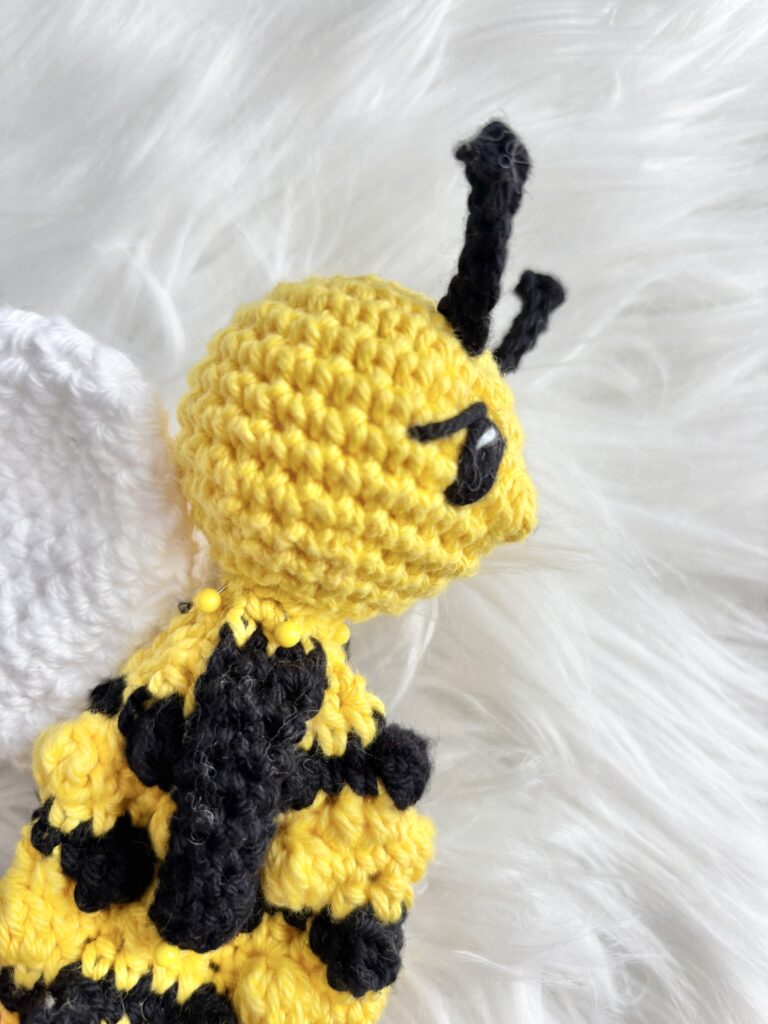
Now, add the features to the face of your bee.
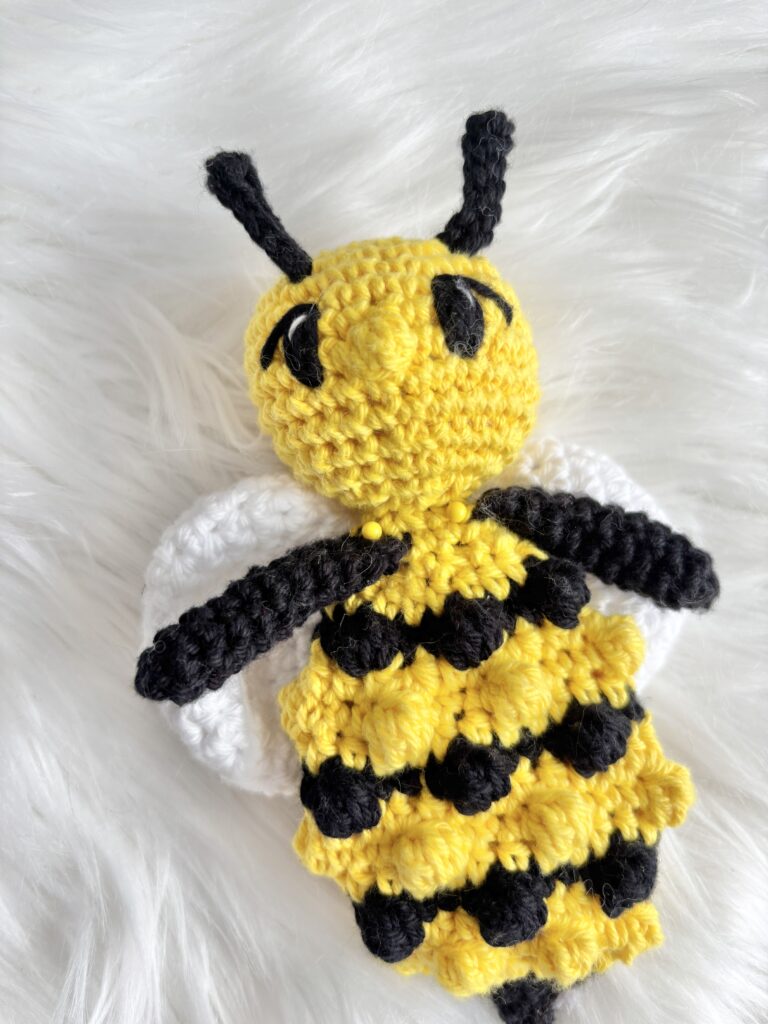
Embroider the eyes on either side of the nose. Work across rounds 6-8 for the eyes. Place eyes ~4 stitches apart. Check out this photo tutorial for more help.
Add antennae on the top of the head. Above the eye slightly towards the outside of the head, work a sl st around a st in round 4. ch 7. hdc into the 2nd chain and then sl st x 5. Tie off and weave ends into head. Repeat for the other side.
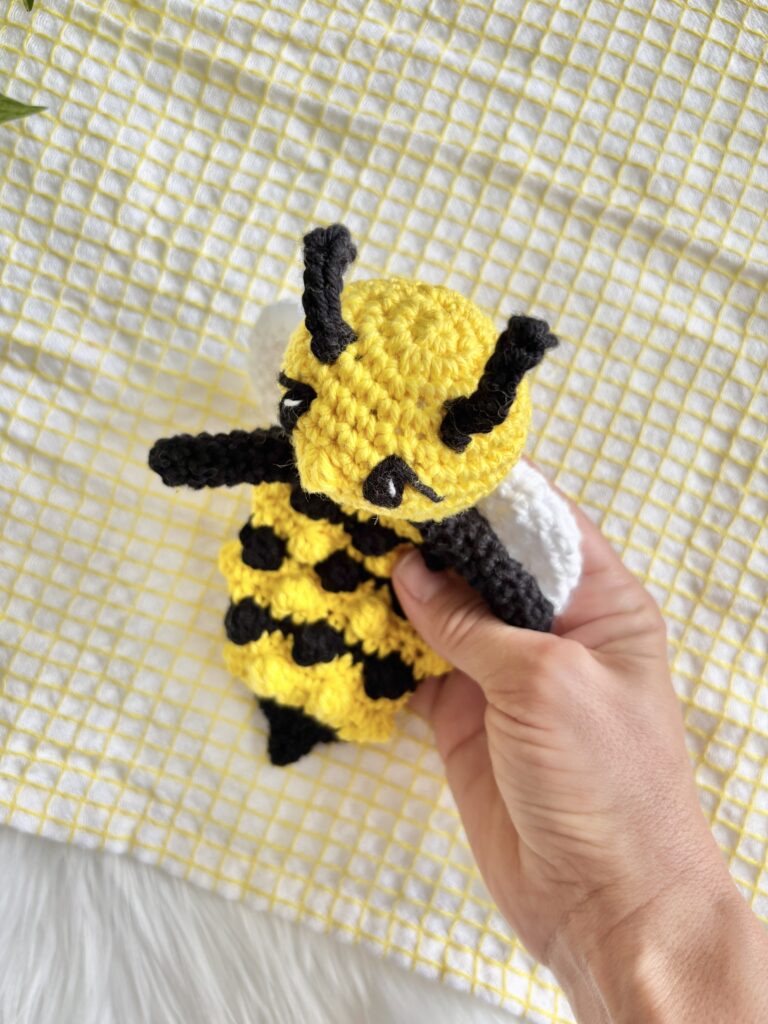
Once you have finished the features and assembly, that’s it! Enjoy your new bitty buddy!
If you liked this free crochet bee pattern bitty buddy, you may also like the other bitties in the collection! Check out the free bitty patterns available here on the website or the bitty collection available on Etsy.
If you make this bitty free crochet bee pattern, I’d love for you to share! On Instagram, use #bittybuddy and tag me @_stuckonyoucrochet_ OR share on Facebook! And if you’d prefer to keep a copy of the ad-free printable version, you can find it on Etsy or Ravelry. Use code BITTY to save on any of the bitty buddy patterns!
Thanks for checking out this free crochet bee pattern and stay tuned for more bitty buddy patterns to come!
Please Note!
This pattern and the pictures are the property of Allison Wasserman and may not be copied, shared, reproduced or sold in part or in whole. The pattern may not be altered or rewritten in any way for resale. You may not use any photos without consent. You are permitted to sell the finished product in small quantities, but please credit the designer by linking to the shop or pattern in your online description.


