The Bitty Lamb Buddy: A FREE Crochet Lamb Pattern
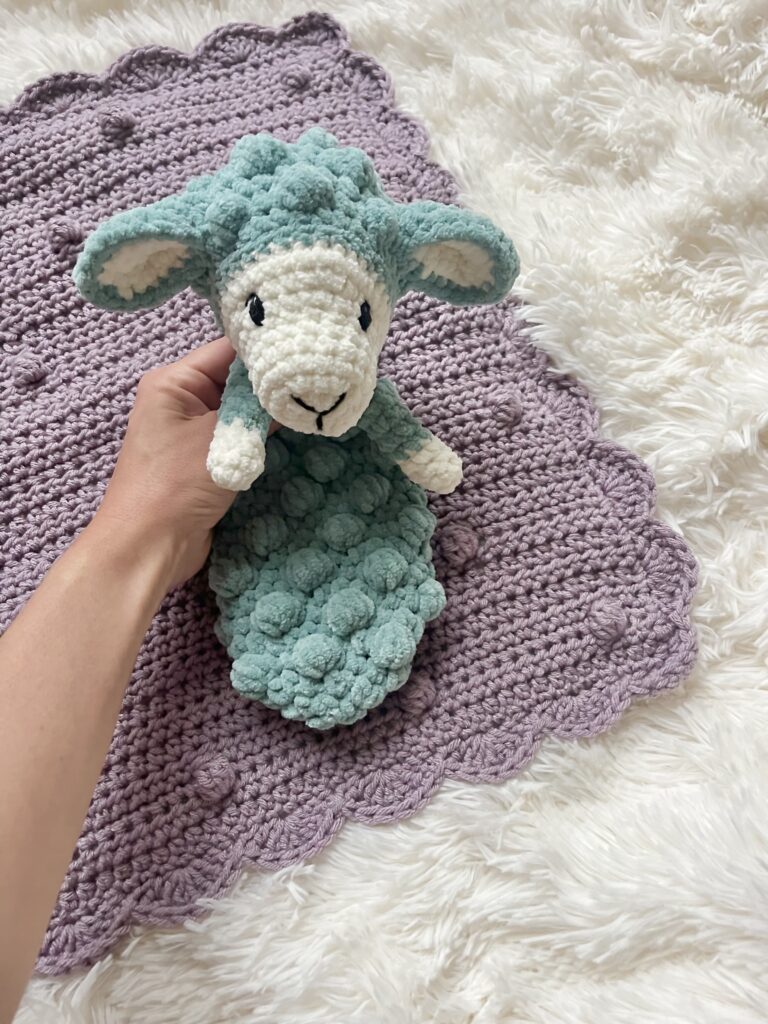
Hello friends! There’s a new bitty ready for FREE release this month – just in time for Easter! Check out the all the details on this FREE crochet lamb pattern.
This adorable, tiny lamb is a perfect project for crocheters of all skill levels. With its sweet little face, soft textured body, and compact size, the Bitty Lamb Buddy makes for a delightful addition to your crochet project lineup. With Easter just around the corner, this little lamb makes a sweet basket stuffer for your little one! The best part? It’s free! Gather your yarn and crochet hook, and let’s get started on crafting this lovable little lamb together.

Remember, if you prefer a pdf of the instructions, you can find the ad-free pdf pattern on Etsy or Ravelry. Use code BITTY to save on any of the bitty buddy patterns!
Don’t forget! I’d love for you to share your work and progress on Facebook or Instagram using #bittybuddyCAL and tagging me @_stuckonyoucrochet_ !
This pattern is being featured as part of the Underground Crafter International Crochet Blog Hop! Today only, you can find the pdf pattern available to download for FREE! During this 31-day blog hop, each designer is sharing a FREE downloadable pattern featuring something they love about crochet! For this design, I’m sharing my love of BOBBLES! The bitty lamb buddy features bobbles all over the body for a pop of texture and neat sensory input.
To snag this FREE pattern, click the image below. Missed the free pattern? Snag the PDF on Etsy or Ravelry!

LET’S GET STARTED:
We will kick off this pattern by making the arms and the body of the bitty lamb. First, we’ll make the arms and then the body. We will crochet the arms into the body as it is being worked so that we won’t need to sew them on later. Less sewing is always a win in my book! The body of the lamb is worked all in the same color but if you would like to add stripes as I’ve shown previously with some other bitties, you can use alternate colors on rounds 4, 6, 8 and 10. Or you can use a variegated yarn as shown below!
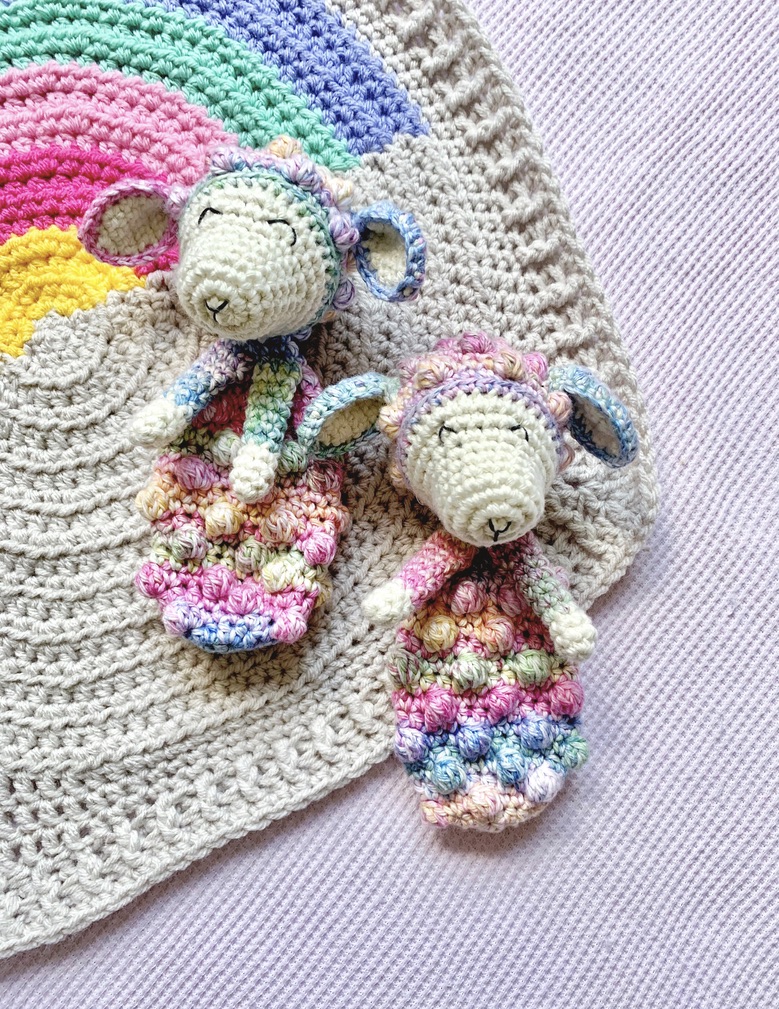
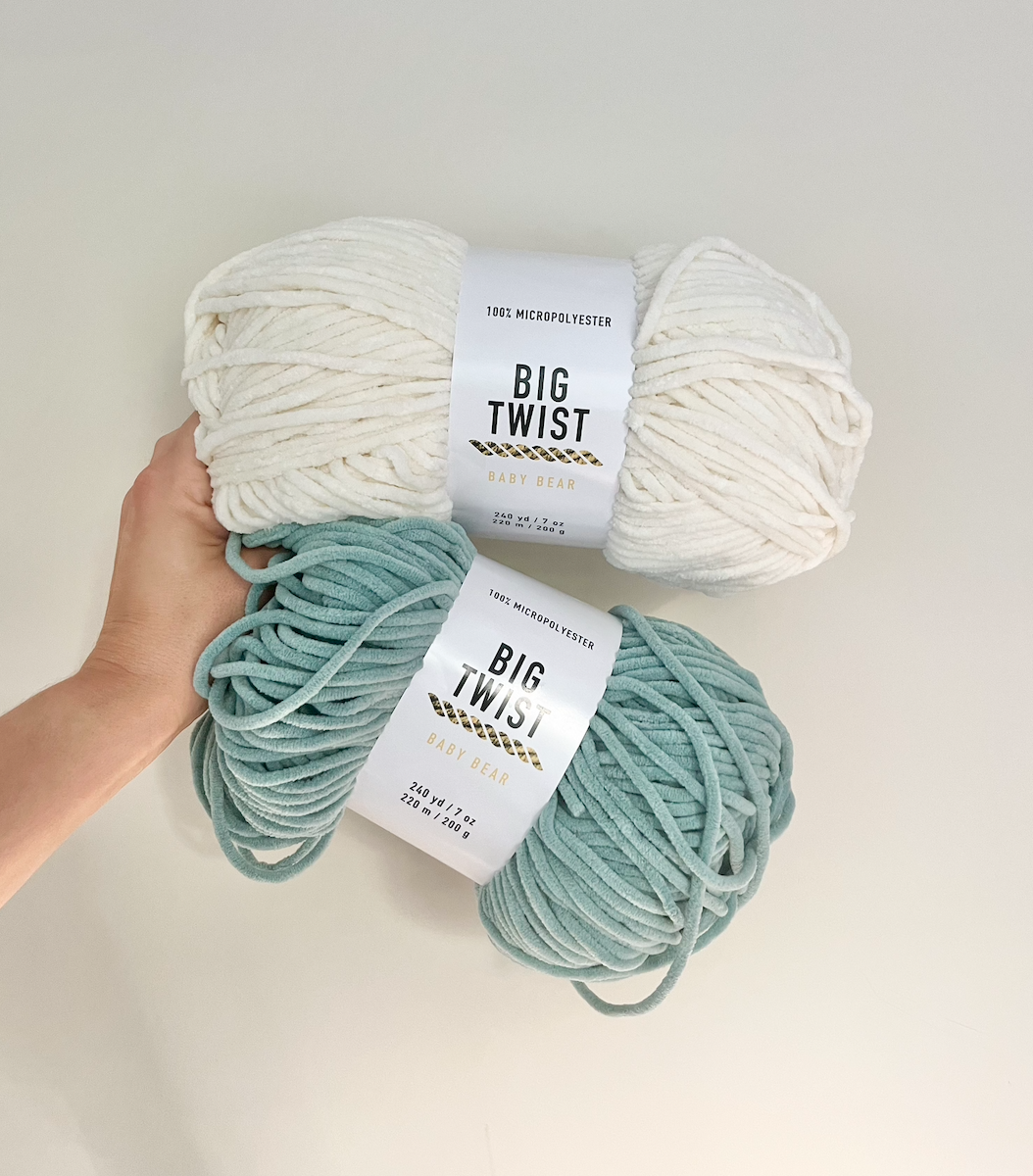
The lamb is worked in two colors – a main color used for the body, arms, back of the ears and most of the head as well as an accessory color used for the hooves of the arms, the muzzle and the inside of the ears. Be sure to pay attention to which color yarn you should be using in each part! My favorite yarn to use for the bitties is I Love This Cotton Yarn from Hobby Lobby. It makes a great teether toy and the 100% cotton yarn is easily washable and holds up well. For plush, I like using either Premier Parfait Chunky or Big Twist Baby Bear. Not as “teethable” but adds to the extra squish factor!
As a reminder, most of my patterns use the bobble stitch and we will be making lots of bobbles on the body of the bunny today! This is a unique stitch that creates bobbles which pop up off of the work to add to the texture and overall look of the project. I work my bobbles in the round by pushing them towards me rather than away from me so they end up on the outside of the work in the round. If you need help with this technique, see the “special stitches” below and check out this video which gives directions on how to work the bobble stitch in the round. The pattern featured in this video is the free pineapple plush, but the technique used is the same!
Please note: This post may contain affiliate links which means that if you purchase through the link, I may receive a small commission at no cost to you. Thank you for supporting my small business!
MATERIALS:
HOOK(S): [My all-time favorite hooks are Clover Amour hooks]
- For Size 4 Cotton/Acrylic Yarn:
2.75 mm • US size C // 4.0 mm • US size G - For Bulkier Yarn (Parfait Chunky):
4.0 mm • US size G // 5.0 mm • US size H
YARN: [I’ve used Hobby Lobby and Premier Parfait Chunky for this project]
Weight : Worsted
Hobby Lobby I Love This Cotton Yarn or Yarn Bee Soft and Sleek
~ 80 yds in Main Color and ~20 yds in Accessory Color
Weight : Bulky
Premier Parfait Chunky
NOTIONS
Darning Needle
Embroidery Thread
Measuring Tape
Polyfil Stuffing
Rattle Insert (if desired)
Scissors
Stitch Marker (if desired)
GAUGE
Exact gauge is not necessary for this project
FINAL HEIGHT
~7.5 // 10-11 inches from top to bottom
STITCH ABBREVIATIONS:

SPECIAL STITCHES:
BOBBLE STITCH (bobble): To make a bobble stitch you will work multiple double crochets into the same stitch. If you need more help, check out THIS tutorial!
- To begin, yarn over and insert hook into the stitch. Yarn over and draw up a loop. This leaves three loops on your hook. Yarn over and pull through the first two loops (two loops left on hook).
- Yarn over, insert hook into the stitch. Yarn over and draw up a loop, leaving four loops on your hook. Yarn over and pull through the first two loops (three loops left on hook).
- Yarn over, insert hook into the stitch. Yarn over and draw up a loop, leaving five loops on your hook. Yarn over and pull through the first two loops (four loops left on hook).
- Yarn over, insert hook into the stitch. Yarn over and draw up a loop, leaving six loops on your hook. Yarn over and pull through the first two loops (five loops left on hook).
- Yarn over and pull through the five loops on the hook. Pull stitch tightly and it will create a bobble. You can choose to make the bobbles on the right or the wrong side of your project, just make sure they are on the outside of the body when finished
DECREASE STITCHES (dec): To decrease stitches, you will sc or hdc 2 stitches together.
INCREASE STITCHES (inc): To increase stitches, you will sc or hdc 2 stitches into the same spot.

PATTERN:
Let’s get started! You will use a 4.0 mm hook for size 4 yarn or a 5.0 mm hook for size 5 yarn. If you use a bulkier weight yarn, you will want to size up to an even larger hook. I don’t recommend super bulky yarn as the bobbles end up kind of bulky and close together, but you may find something that works with a large hook size!
MAKING THE ARMS (MAKE TWO):
Round 1: Start with accessory color. To begin, make a magic circle. Place 6 sc in the magic circle. [6] Do not join. You will continue to work in the round.
Rounds 2-4: sc x 6 around. At end of row 4, switch to main color. [6]
Rounds 5-11: sc x 6 around. [6]
Round 12: Pinch the top of the arm together and place 3 sc through each side in order to close off the arm. [3] Cut yarn, tie off and weave in ends.
MAKING THE BODY:
Stitch counts are included at the end of each round. Bobble rows include [total # stitches, # bobble stitches]. You will not join at the end of each row. You will continue to work in the round.
For rounds with increases and decreases, they will always be done with a hdc stitch, not a sc stitch. sc stitch will only be used on rounds that also have bobbles.
Round 1: To begin, make a magic circle. Place 6 hdc stitches in the magic circle. [6] Do not join. You will continue to work in the round.
Round 2: [inc] x 6 around. [12]
Round 3: [inc, hdc] around. [18]
Round 4: [sc x 2, bobble] x 6. [18, 6 bobbles]
Round 5: [inc, hdc x 2] around. [24]
Round 6: sc x 2, bobble, [sc x 3, bobble] x 5, sc. [24, 6 bobbles]
Round 7: hdc x 24 around. [24]
Round 8: sc, [bobble, sc x 3] x 5, bobble, sc x 2. [24, 6 bobbles]
Round 9: hdc x 24 around. [24]
Round 10: [bobble, sc x 3] x 6. [24, 6 bobbles]
Round 11: hdc x 24 around. [24]
Round 12: [sc x 3, bobble] x 6. [24, 6 bobbles]
Round 13: hdc x 24 around. [24]
Round 14: sc x 2, bobble, [sc x 3, bobble] x 5, sc. [24, 6 bobbles]
Round 15: [hdc x 2, dec] x 6. [18]
Round 16: sc, [bobble, sc x 2] x 5, bobble, sc. [18, 6 bobbles]
Round 17: hdc x 18 around. [18]
Round 18: [hdc, dec] x 6. [12]
At this point, you will add the arms to your bunny to avoid having to sew them in later. The arms should be closed with three stitches across. Add in arms as below:
Round 19: sc x 3. For the next three stitches, place your first arm on the outside of the body and sc x 3 through both the arm and the stitches of the neck. This will attach your first arm. sc x 2. For the next three stitches, place your second arm on the outside of the body and sc x 3 through both the arm and the stitches of the neck. This will attach your second arm. sc x 1 to finish the round.
Round 20: [dec, sc x 2] x 3. [9] Slip stitch to first stitch and then, leaving a long tail, cut yarn and tie off. You will use this tail to attach the head to your body, so be sure to leave a long enough tail!
Need more help? You can check out this YouTube tutorial for making the body of the bitty bunny here. While this is a different bitty buddy, the body style and technique used to create it is the same!
MAKING THE EARS (MAKE TWO)
*For the ears of the lamb, grab your 2.75 mm (C) hook if you are using worsted weight yarn or your 4.0 mm (G) hook if you are using bulky weight yarn! The ears are meant to be pretty large and floppy along the sides of the head. However, if you find that your ears are too large, you can size down on hook size to make them a little smaller!
To make the ears, you will start by making the inside of the ear in your accessory color. You will repeat the pattern to make the outside of the ear in your main color. Do not cut yarn after finishing your outer ear as you will immediately move on to joining the inner and outer ears together. You will repeat this twice in order to create two ears for your lamb.
Row 1: To begin, ch 3. Working in the second ch from your hook, sc x 2 across. Ch 1 and turn. [2]
Row 2: [inc] in each st. Ch 1 and turn. [4]
Row 3: inc, sc, sc, inc. Ch 1 and turn. [6]
Rows 4-7: sc x 6 across. Ch 1 and turn. [6]
Row 8: dec, sc, sc, dec [4]
For inner ear (in accessory color), cut yarn, tie off and weave in ends.
For outer ear (main color), do not cut yarn. Move to joining instructions.
JOINING THE INNER AND OUTER EAR
To join the inner and outer ears, place your inner ear on top of your outer ear. Ch 1 with the working yarn of your outer ear. You will now sc through both pieces, thus joining them together as you go around. I like to put two sc in each of the corners along the top. I place about 22 sc stitches after going around.
Sc completely around the entire ear. Sl st to first sc. Ch 1. Fold ear in half and sc 2-3 stitches across the top, joining the top of the ear together so it stays folded. Leaving a tail for sewing, cut yarn and tie off. Need more help figuring out how to make your ear? See my video tutorial.

MAKING THE HEAD
*For the head of the lamb, you’ll use a 4.0 mm hook if you are using worsted weight yarn and a 5.0 mm hook if you are using bulky weight yarn. However, if you have loose tension, you may wish to use a 3.75 mm // 4.5 mm hook for head. The head will be the only part of the bitty buddy that is stuffed, so you’ll want to make sure the stitches are nice and tight!
Round 1: Start with your accessory color for the face of the lamb. To begin, make a magic circle. Place 6 sc in the magic circle. [6] Do not join. You will continue to work in the round.
Round 2: [inc] in each st around. [12]
Round 3: [inc, sc] x 6 around. [18]
Rounds 4-7: sc x 18 around. [18]
Round 8: [inc, sc x 2] x 6 around. [24]
Round 9: [inc, sc x 3] x 6 around. [30]
Round 10: [inc, sc x 14] x 2 [32] Switch to your main color for the head of the lamb.
Round 11: sc x 32 in the front loop only (FLO) around. [32]
Round 12: sc x 32 in the back loop only (BLO) around. [32]
Round 13: sc x 2, bobble, [sc x 3, bobble] x 7, sc [32, 8 bobbles]
Round 14: sc x 32 around. [32]
Round 15: [bobble, sc x 3] x 8 [32, 8 bobbles]
Round 16: [dec, sc x 2] x 8 around. [24]
*Stop here and begin stuffing head firmly. Add a rattle insert, if desired, as you work towards closing up the head. If you are using safety eyes, add them now. If you’d like to add the facial features before closing the head, scroll down to facial features and add them now.
Round 17: sc, [bobble, sc x 2] x 7, bobble, sc [24, 8 bobbles]
Round 18: [dec, sc x 2] x 6 around [18]
Round 19: [dec, sc] x 6 around. [12]
Round 20:[dec] in each st around. [6]
Leaving a bit of a tail, cut and tie off your yarn. Thread a needle and sew under the front loop of each remaining stitch. Cinch tightly together to close the head. Tie off and weave in your ends.
ADDING THE FEATURES
There are many options for the eyes of the bitty buddies. You can use safety eyes or embroider the eyes in a number of different fashions. I prefer to embroider the eyes since I typically make rattles that are meant for teething babies! The eyes can be embroidered in a v-shape, right side up or upside down. Or you can embroider around the stitches to make a true eye shape. Embroidery is something that I have been working on to improve. It requires some patience at times, but I do love when I can get the look just right (and have two eyes that actually look like each other!).
Embroider the eyes (or place safety eyes) at row 9 (one row from the color change to the head). I usually make a simple upside-down V stitch across the row and leave 4-5 stitches in between the eyes. If you feel like the eyes are set too far apart, you can use a strand of the accessory color yarn and pull the sides of the face together to shape the muzzle a little better. This is a technique used in many of my bobble buddies to help give some definition to the face shape!
To make your nose, use embroidery thread to make a “Y.” The bottom of the “V” of your nose will start in the center of the magic circle. The top of the “V” of your nose will be in row 1, one or two stitches wide across the top.
Push your needle up through the center of the magic circle and pull across diagonally up a row or two to the side of the nose. Insert the needle back into the head. Leaving one or two stitches in between, pull straight across to the other side of the nose and push the needle up. Then, pull across diagonally back to the bottom stitch. Insert the hook back into the head and this should create a V shape. You will create the bottom of the “Y” by pushing the needle up through a stitch in row 2 (below the bottom of the v) and then pull up to re-insert through the middle of your magic circle and back to the bottom of the “V.” Tie off and cut yarn. (Don’t worry…if this makes no sense, there is a video linked below!)
To add the ears, I recommend using pins to ensure placement before stitching them to the head. It can be a little tricky to add the ears around the bobbles, so just do your best! I add my ears in line with the eyes and angle slightly up across the bobbles of the head. Tie off, cut yarn and weave ends.
Need more help? Check out my YouTube video for instruction on adding features here.
ASSEMBLY OF YOUR BITTY BUDDY
On to assembly (hooray!). You should now have the body with two attached arms from part one and the head with facial features completed. Next, you’ll attach the body to the head. You will use the yarn tail from the neck of the body to sew to the head. I highly recommend using pins to make sure that your head is sewn on straight and centered to the body. Place the pins up through the neck of the body into the head to hold everything in place and make sure it is all centered correctly. The nose should be centered between the arms. I like to start at the back of the body/head and move around the front. Carefully stitch through the body and head to attach. Sometimes, I will stitch around the head twice just to make sure it is extra secure!
If you need help with attaching the head, check out my YouTube tutorial.

Alright, that should be it! Your bitty lamb is all finished up and ready for some sweet snuggles. If you want, you can consider adding a teether ring or a chain to the head of the bitty buddy to turn it into a binky buddy. My daughter used to love these when she was little! These options are included in the pdf pattern for the bitties. I hope you enjoyed following along with this project!
Please Note!
This pattern and the pictures are the property of Allison Wasserman and may not be copied, shared, reproduced or sold in part or in whole. The pattern may not be altered or rewritten in any way for resale. You may not use any photos without consent. You are permitted to sell the finished product in small quantities, but please credit the designer by linking to the shop or pattern in your online description.